
Why post-acceptance enrollment ops break down
Most admissions teams run a strong process through inquiry, tour, and decision. Friction spikes after acceptance, when families must complete contracts, submit missing documents, and make payment choices across multiple systems.
At that stage, staff are usually managing:
- fragmented checklist statuses across portals and inboxes
- repetitive reminder emails that are hard to personalize at scale
- handoff gaps between admissions and business office teams
- unclear escalation rules for accounts that are at risk of stalling
The result is predictable: accepted families that should enroll end up delayed or dropped because small blockers are not resolved quickly enough.
What the AI-assisted recovery workflow looks like
A reliable workflow is not "send more reminders." It is a structured decision flow with explicit triggers and ownership.
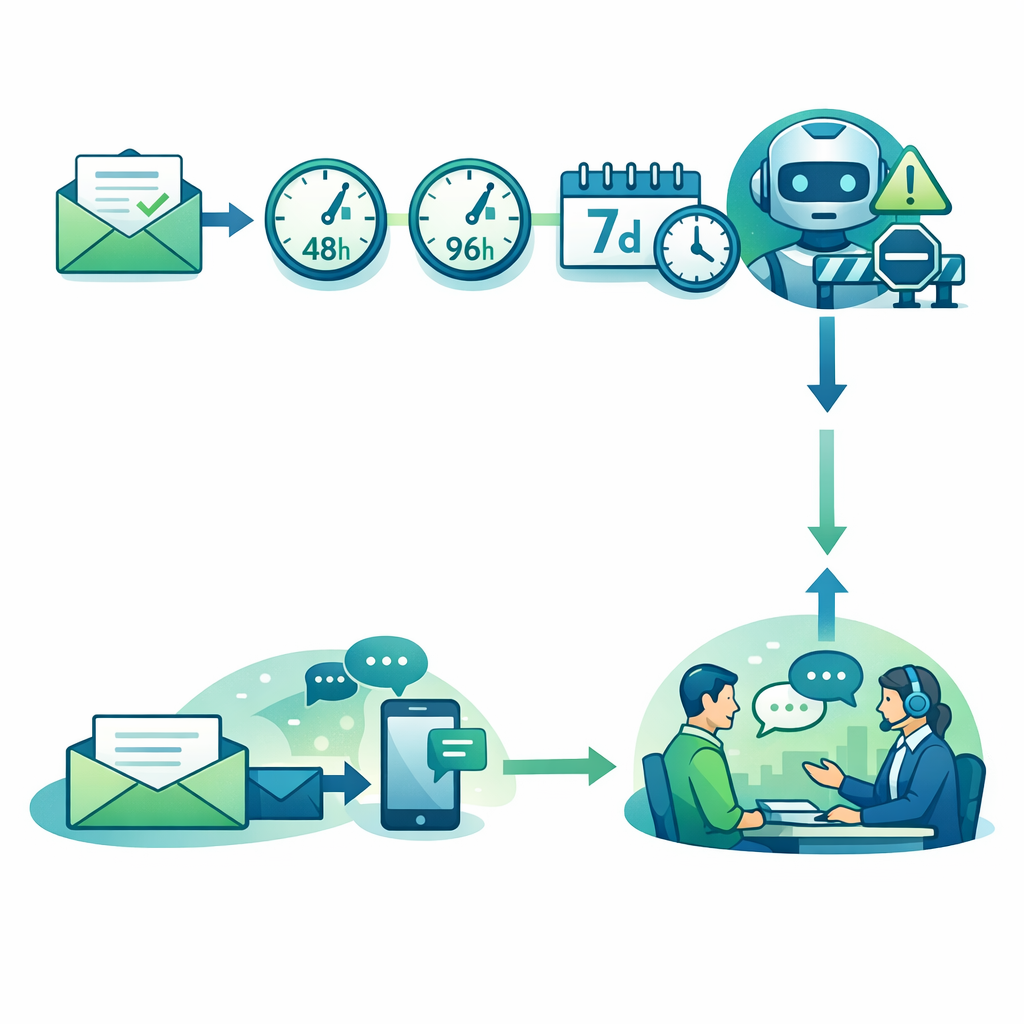
1) Detect stalls with operational thresholds
Define simple, visible thresholds such as:
- 48 hours after contract issued with no signer activity
- 96 hours with missing required upload
- 7 days with signed contract but no deposit completion
This creates a shared operating language and removes ambiguity about when action is required.
2) Classify blocker type
Use AI to classify likely blockers from checklist status, activity logs, and intake notes:
- missing signer
- missing upload
- payment-plan confusion
- unresolved policy question
Classification quality matters because each blocker needs a different next action.
3) Trigger next-best action by blocker
Pair each blocker with a deterministic response path:
- targeted email with one clear CTA
- SMS follow-up only if no response in a defined window
- staff task escalation for high-risk or repeated non-completion
This keeps communication helpful instead of noisy.
Tool stack that fits this use case
You do not need a net-new platform to run this. Most schools can layer automation over current systems.
| Layer | Practical role |
|---|---|
| Enrollment system (e.g., Blackbaud, Finalsite Enrollment, TADS) | Source of truth for contracts, checklist items, and status changes |
| AI classifier | Assigns likely blocker type and drafts context-specific reminder language |
| Workflow automation (native, Make, Zapier, n8n) | Executes reminder sequences, escalations, and owner routing |
| Messaging stack (email + SMS) | Delivers sequenced outreach with cadence control and logs |
| Reporting dashboard | Tracks issued → signed → deposit paid → fully enrolled funnel metrics |
The key design rule: AI can recommend language and priority, but send policies and escalation logic should remain deterministic.
A realistic 6-week rollout plan
A tight pilot beats a broad, risky launch.
Weeks 1-2: Define rules and data hygiene
- finalize checklist taxonomy and owner mapping
- agree on stall thresholds and suppression logic
- approve message templates by blocker type
Weeks 3-4: Launch two blocker classes
Start with only:
- missing signer
- missing upload
Keep human review on outbound copy while measuring response and completion behavior.
Weeks 5-6: Add routing and exception management
- route unresolved cases to admissions or business office automatically
- publish a daily exception digest: "act today" vs "awaiting family"
- monitor escalation yield and adjust thresholds

Metrics to prove operational impact
Track a compact set of outcome metrics:
- contract completion rate within 7 days of issue
- median time to resolve missing checklist items
- deposit completion rate before deadline
- manual follow-up touches per enrolled student
- escalated-case completion rate within 72 hours
If these move in the right direction, the workflow is working. If they do not, adjust thresholds and sequencing before adding complexity.
Governance and risk controls
Admissions workflows can involve sensitive student and family data, so governance is not optional.
Use guardrails such as:
- role-based access to records and outbound actions
- audited send logs and escalation history
- cadence caps to avoid reminder fatigue
- manual override for aid appeals and edge-case accounts
- policy checks aligned to FERPA and school data governance requirements
Final takeaway
Enrollment losses after acceptance are often operational, not strategic. Schools that treat contract and document recovery as a governed workflow can improve completion rates fast.
AI is most useful here when it helps teams prioritize the right account, send the right message, and escalate at the right time.
That is how you turn "accepted" into "fully enrolled" more consistently, without burning out staff or overwhelming families.