
Why this problem matters
Most private schools already capture attendance daily in their SIS. The breakdown happens after data entry.
When absences are reviewed manually, outreach timing depends on who notices the pattern first. Some students get contacted the same day, others slip until a weekly review, and by then the intervention window is smaller. Teams work harder, but outcomes do not reliably improve.
The operational issue is not missing data. It is missing orchestration:
- no consistent trigger for who gets contacted when
- no standard escalation from advisor to counselor/dean
- no shared way to measure whether interventions changed attendance behavior
An AI attendance layer should solve those workflow gaps, not replace school judgment.
What the workflow looks like
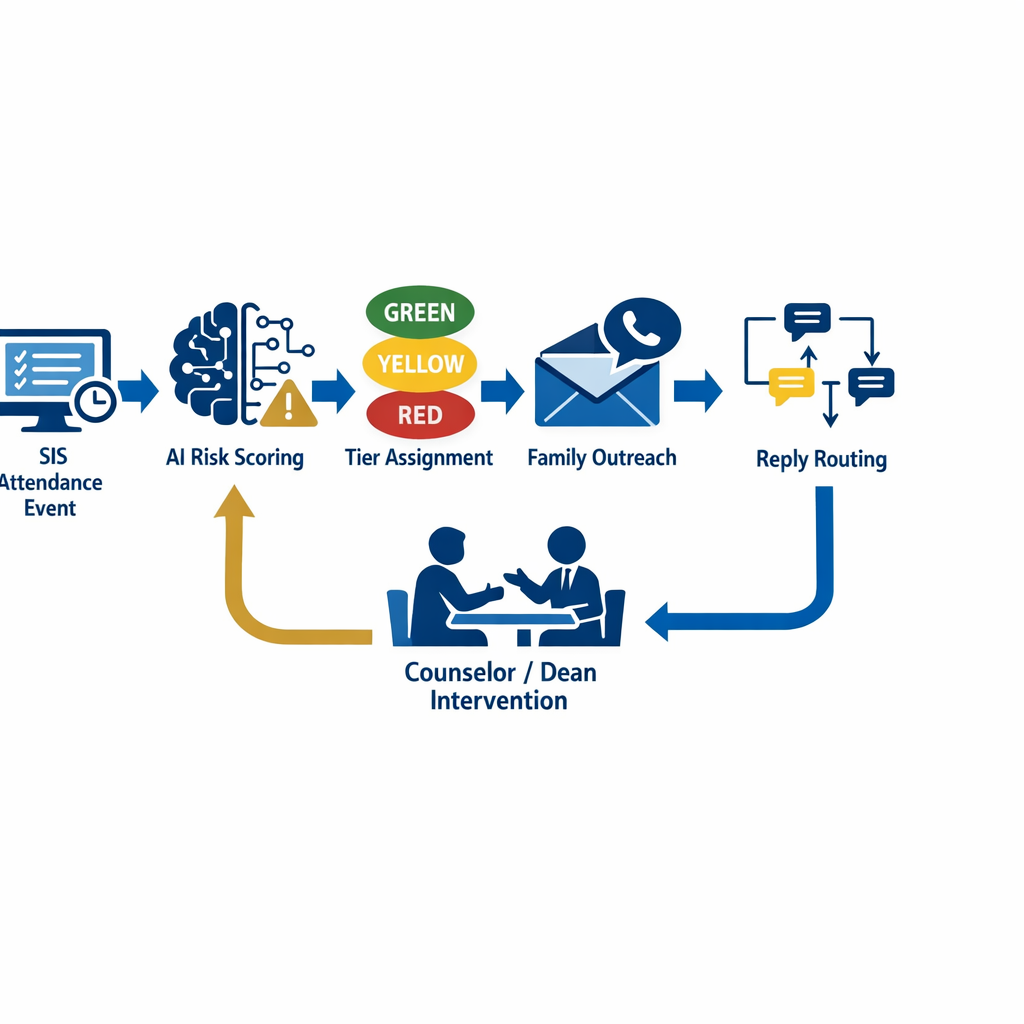
A practical attendance early-warning system uses existing SIS records plus clear intervention logic.
Step 1: Build a daily risk watchlist
Use previous-day events and short-term trend features to bucket students into:
- Green: normal variation, no immediate action
- Yellow: early risk signals, trigger Tier 1 outreach
- Red: sustained or escalating absence pattern, trigger Tier 2/3 escalation
Start with transparent rules such as:
- Absences in trailing 30 days
- Tardy frequency trend
- Attendance rate decline vs prior period
- Repeat pattern by day or class block
Step 2: Trigger tiered outreach
Tie each risk bucket to a documented intervention path.
| Tier | Trigger example | Owner | Action | SLA |
|---|---|---|---|---|
| Tier 1 | 3 absences in 30 days | Advisor | Family nudge with context + check-in options | Same day |
| Tier 2 | 5 absences or worsening trend | Advisor + counselor | Conference request + barrier discovery | 48 hours |
| Tier 3 | >=10% days missed or persistent no-response | Dean/counselor team | Formal support plan + follow-up cadence | 5 school days |
This keeps interventions predictable across divisions and prevents alert fatigue.
Step 3: Use AI as a communication co-pilot
AI should draft, not decide, the sensitive parts:
- produce family-facing messages in preferred language
- insert verified attendance facts from SIS
- include barrier-intent options (transportation, health, schedule)
- route replies to the right staff queue with suggested next actions
For high-risk cases, staff should approve messages before send.
Tools that fit this use case
You do not need a full platform migration to launch this.
- SIS (Blackbaud, FACTS, TADS, PowerSchool): source-of-truth events, reason codes, family contacts
- Rules engine + lightweight feature layer: deterministic thresholds and trigger control
- LLM drafting layer with guardrails: consistent school tone, multilingual support, policy-safe language
- Messaging channel stack (SMS/email/app): delivery, replies, and intent capture
- Dashboarding: intervention latency, response rates, and attendance movement by cohort
Design principle: keep the first version boring and auditable. Schools trust workflows they can inspect.
What a realistic rollout looks like
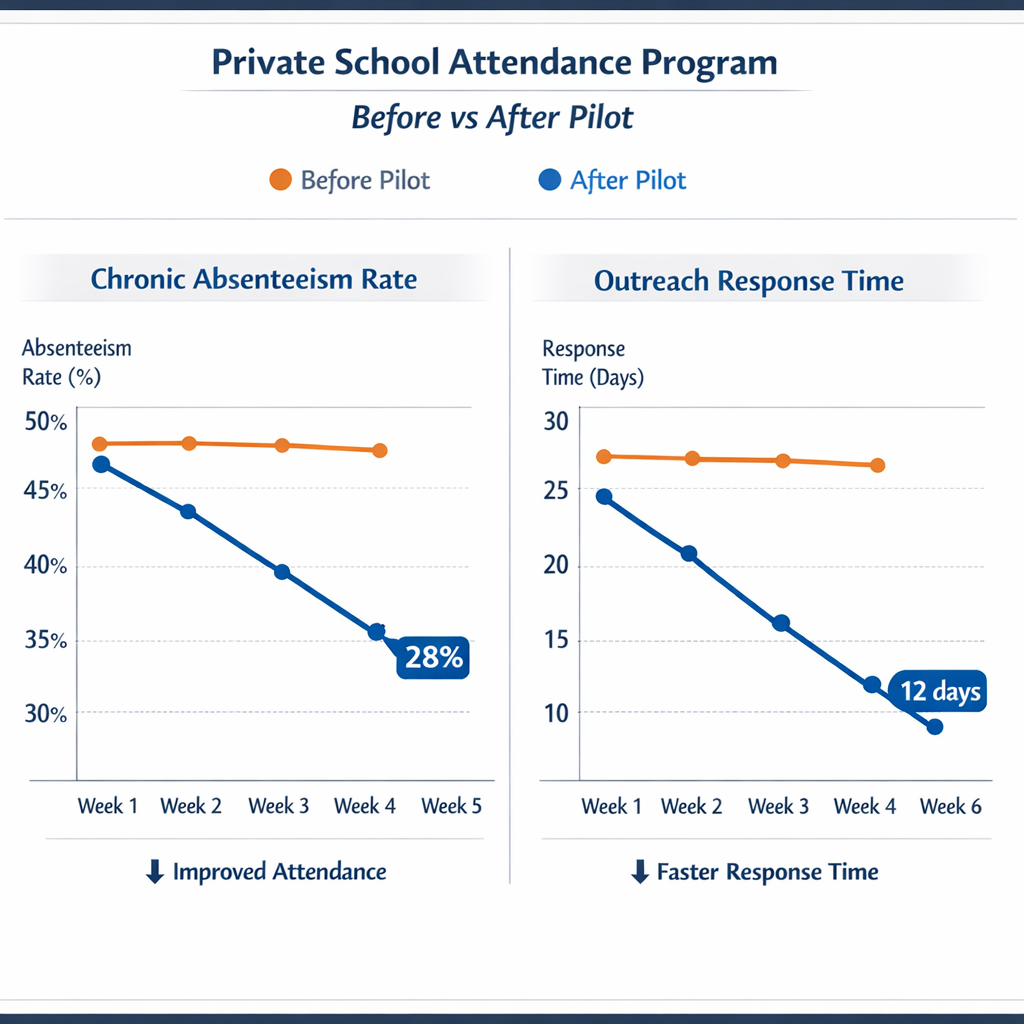
A 6-week pilot in one division is usually enough to prove whether the workflow improves outcomes.
Week-by-week rollout
- Weeks 1–2: Standardize attendance reason-code usage and define escalation thresholds.
- Weeks 2–3: Implement daily SIS export and rule-based watchlist.
- Weeks 3–4: Add AI outreach drafts with approved templates.
- Weeks 4–6: Run advisor/dean cadence and compare with prior baseline.
Metrics that matter
Track a small set of operational and student-outcome signals:
- chronic absence rate by grade/division
- average time from absence event to first outreach
- 30-day re-attendance lift after first intervention
- family response rate by channel/language
- staff hours saved from manual follow-up
Risks and controls
Common failure modes are predictable and manageable:
- Data quality drift: enforce reason-code governance and periodic audits
- Tone/compliance mistakes: keep template guardrails and approval paths
- Alert overload: cap daily queues and tighten threshold definitions
- Ownership confusion: publish SLA ownership by role and division
If ownership and data quality are weak, model sophistication will not rescue outcomes.
Final takeaway
Private-school attendance improvement is an operations discipline first, an AI problem second.
Start with daily watchlists, tiered interventions, and measured outreach latency. Once those mechanics are stable, AI can meaningfully improve speed, consistency, and family responsiveness without increasing staff burden.