Why this problem matters
Private-school admissions teams are under pressure to respond quickly while keeping every interaction thoughtful and accurate. That gets difficult when inquiry volume spikes and staffing is lean.
Sector signals are clear: most inquiries begin on website forms, and follow-up remains a recurring bottleneck. In many schools, the same small team is handling tours, interviews, parent calls, and repetitive first-touch email work at the same time.
When response time slips, two problems appear fast:
- families lose momentum and compare options elsewhere
- staff attention shifts from high-value conversations to inbox triage
AI can help here, but only if the workflow is designed for operational control rather than automation theater.
What the workflow looks like
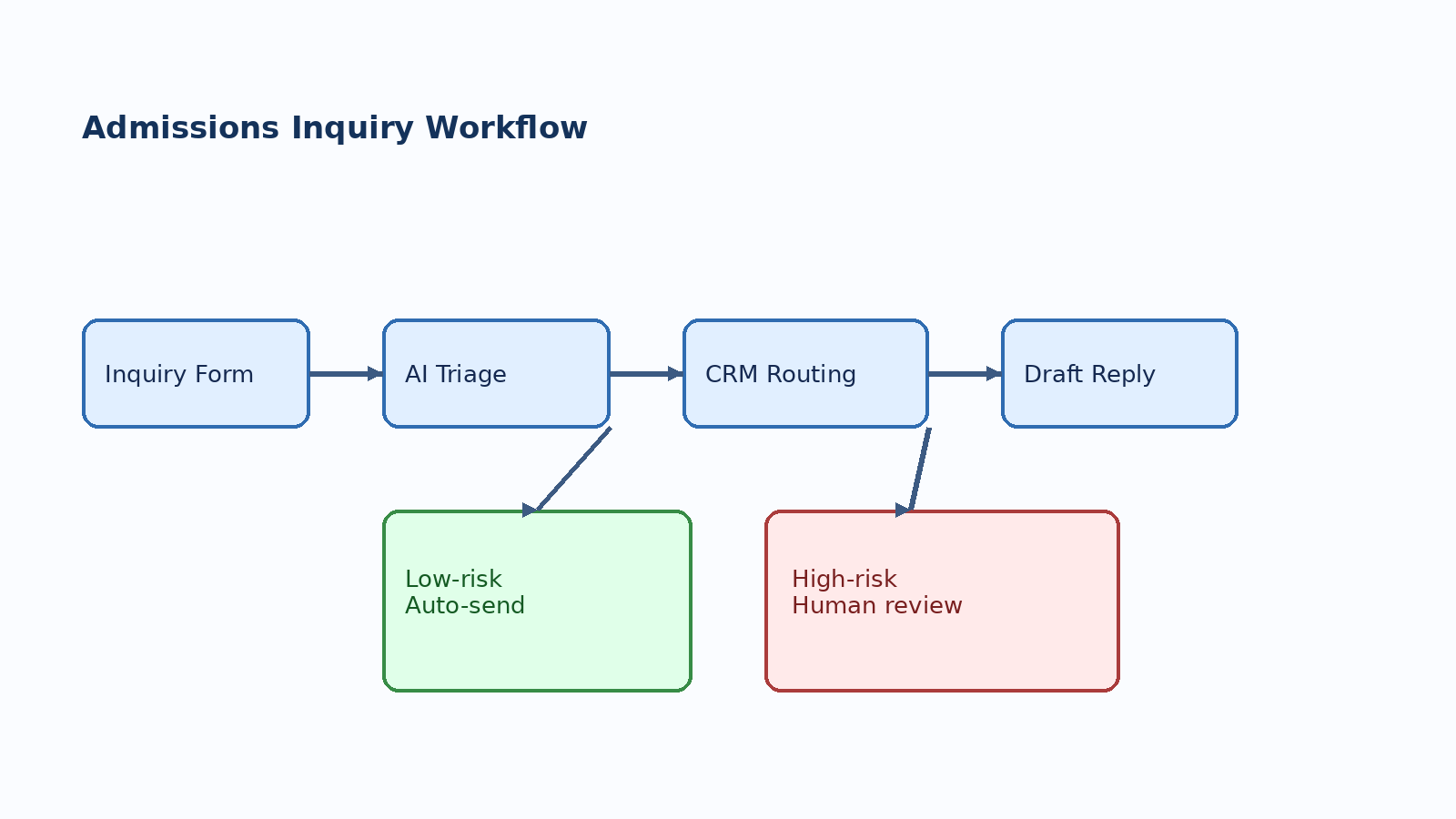
A practical model places AI between inquiry capture and staff action. The goal is faster first-touch and better routing, not removing humans from admissions decisions.
Step-by-step flow
- Website form submission enters the admissions pipeline.
- AI classifies intent (for example: tuition aid, academics, tour, transfer timing, international).
- CRM assigns owner and SLA based on intent and grade/program interest.
- AI drafts a first response from approved school knowledge.
- Low-risk informational messages can send automatically.
- High-risk or nuanced topics are routed to human-only review.
Mandatory guardrails
- never allow auto-send for financial aid edge cases or student-support-sensitive topics
- preserve approval history for every AI-generated response
- keep source content in a maintained admissions knowledge base
- enforce data minimization in prompts and integrations
Tools that fit this use case
A workable stack combines existing enrollment software with a lightweight AI and automation layer:
| Layer | Role |
|---|---|
| Enrollment CRM (Finalsite Enrollment, OpenApply, or similar) | Record, ownership, pipeline progression, and reporting |
| LLM service layer | Intent classification, draft response generation, context summaries |
| Automation platform (Zapier, Make, n8n) | Event glue across forms, CRM updates, and messaging actions |
| Human review queue | Approval path for high-risk categories and quality control |
The architecture should stay boring and auditable. Schools get better outcomes when they optimize handoffs and response quality, not when they chase a fully autonomous inbox.
What a realistic rollout looks like
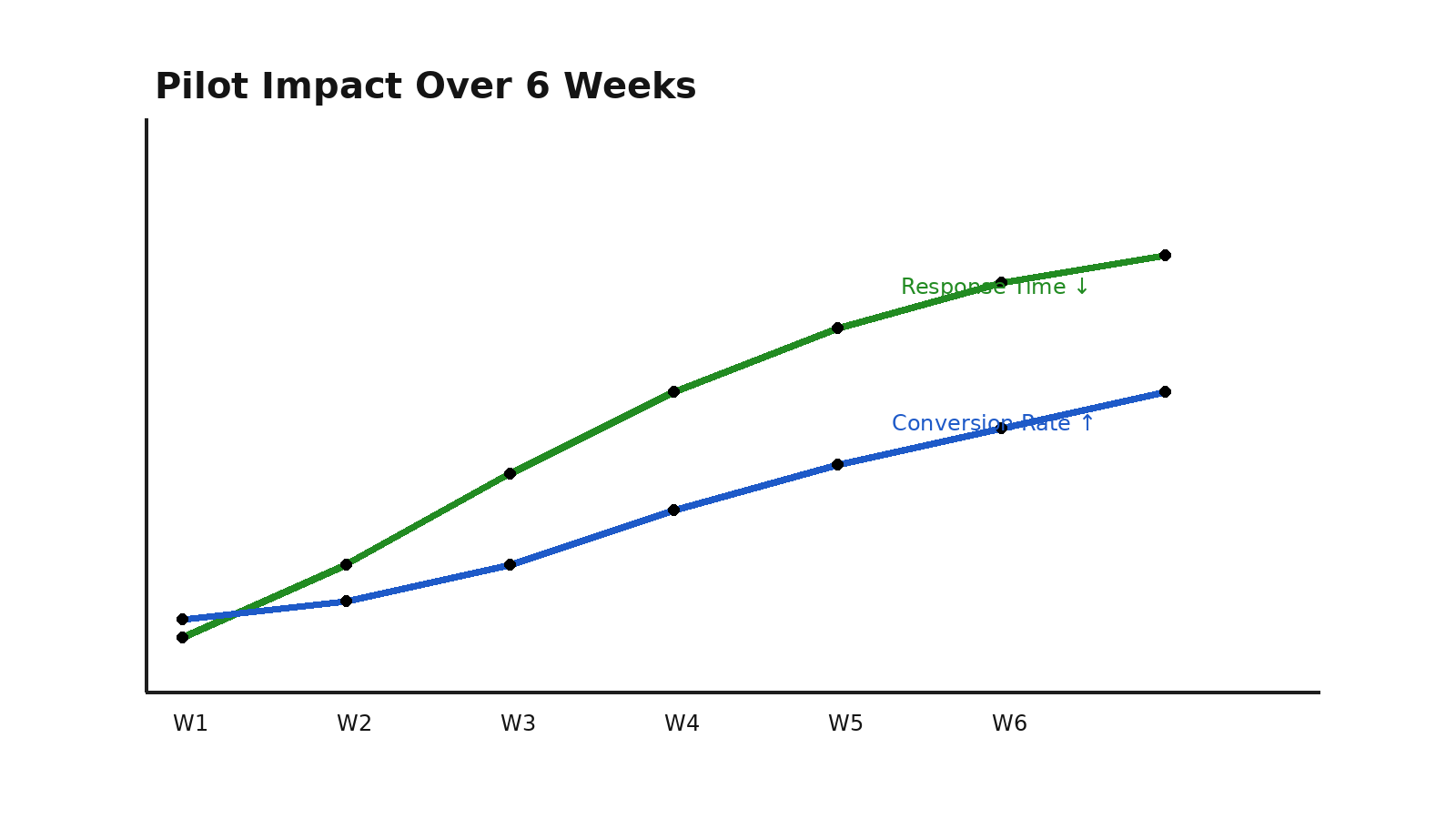
A 6-week pilot is enough to prove value and expose integration gaps.
Weeks 1-2: Baseline and taxonomy
- measure current median time-to-first-response
- measure inquiry backlog age and inquiry-to-tour conversion
- define 8–12 intent labels and escalation rules
Weeks 3-4: Draft-only to hybrid mode
- integrate form, CRM, and AI in draft-only mode first
- move to hybrid mode with low-risk auto-send only
- require approvals for policy-sensitive categories
Weeks 5-6: Tune and decide scale
- compare against baseline
- refine prompts, templates, and routing thresholds
- evaluate staff acceptance and parent communication quality
Metrics to track
- median time-to-first-response
- percent of inquiries answered within SLA
- inquiry-to-tour conversion rate
- inquiry-to-application-start rate
- staff hours spent on repetitive first-touch communication
- AI draft acceptance rate without edits
Final takeaway
Private-school admissions teams do not need a fully automated inbox. They need a controlled system that responds faster, routes smarter, and protects trust when conversations become nuanced.
The strongest implementation pattern is simple: AI for triage and drafting, humans for judgment and high-stakes communication, and metrics that prove whether the workflow is actually improving enrollment operations.